
Who Shapes the Response to the Climate Crisis? Why It Cannot Be Resolved from Inside the Financial System?
6th of February, 2026
On the 5th and 6th of February 2026, the University of St. Gallen (HSG) hosted a symposium titled “Banking on Climate Action: The Role of Banks in the Climate Crisis”, aiming to bring together European researchers and practitioners working at the intersection of banking, climate mitigation and civil society.
The associated research project asks an important question: “To what extent, and through which processes, do different types of non-state pressures affect climate-relevant financing and strategic decisions in banks?”
Understanding civil society’s influence is essential. But the credibility of such research depends not only on analytical rigour. It also depends on who is invited to speak, and whose experience is considered relevant evidence.
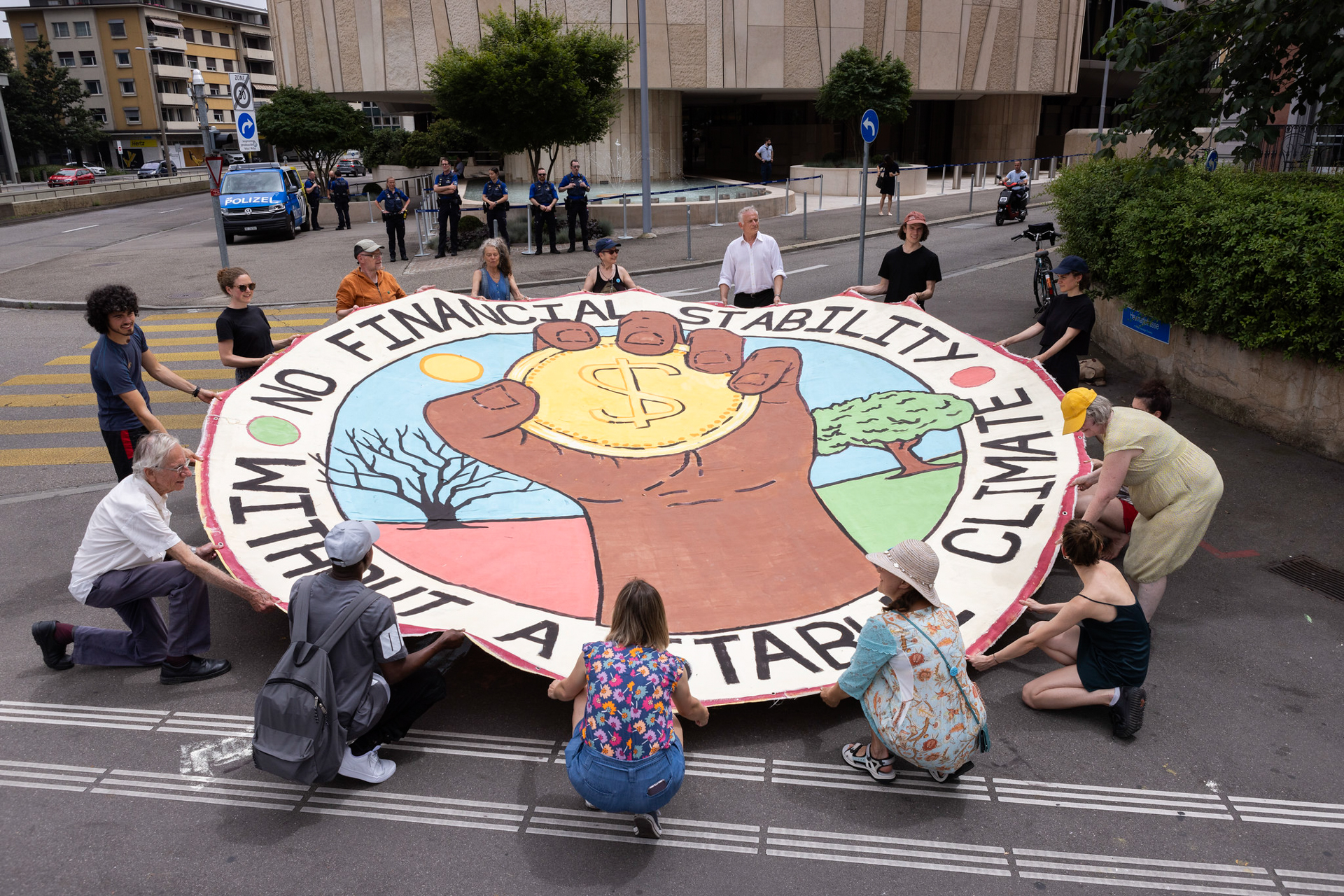
In Switzerland, pressure on financial institutions has not stemmed solely from institutional NGOs, or structured stakeholder dialogues. It has also been driven by grassroots and youth-led mobilisation: mass demonstrations, public campaigns, reputational challenges, shareholder actions, negotiations and sustained volunteer engagement. Movements and organizations such as Climate Strike Switzerland, Campax, Climate Alliance, Collective Climate Justice, Greenpeace, BreakFree Suisse and others have played a visible role in shaping public debate, influencing media narratives, and contributing to shifts in banks’ fossil fuel policies (1).
However, none of these organizations were invited to the symposium’s public panel, addressing the question: “How can civil society influence banks’ strategic and financing decisions?” Instead, the discussion included a senior representative of Swiss Sustainable Finance, a finance-aligned organisation whose mandate is to promote Switzerland as a sustainable finance hub.
This choice raises concerns of representativity, perspective and independence. When panels on civil society influence are composed primarily of academics, NGOs and actors closely linked to the financial ecosystem, the range of viewpoints narrow. Narratives framing change as gradual, consensual and compatible with existing practices tend to dominate, while more confrontational forms of activism, often decisive in increasing reputational pressure, are sidelined. Several prominent academics in this field are affiliated with or funded by institutions such as the Swiss Finance Institute, whose mandate includes strengthening Switzerland’s financial sector. Even without overt bias, such proximity warrants transparency and critical reflection.
This leads to a deeper institutional question. Should debates on climate finance remain largely confined to academic and financial circles that reproduce free-market paradigms as default frameworks? Or should universities more deliberately open these spaces to grassroots movements and to communities directly affected by financial decisions? If we seek to understand how activism influences finance, and how finance might genuinely contribute to a sustainable future, the architects of the proposed solutions cannot come predominantly or exclusively from within the financial ecosystem itself.
Some speakers highlighted familiar tools: ESG metrics, pricing externalities, investor engagement, market signals. These instruments are not without value. But they have been debated and refined for over a decade, during which global emissions have continued to rise, biodiversity loss has intensified, and fossil fuel financing has persisted. The Swiss financial centre has been notably slow to align capital flows with climate science. Without binding regulation, a reassessment of fiduciary duty, and governance reforms that move beyond short-term return imperatives, progress will not occur at the pace required.
There is a fundamental question of means and ends behind. Can a crisis rooted in extractivism, short-term profit maximisation and the commodification of living systems be resolved through incremental adjustments to those same logics? How can we claim to address the climate crisis while relying on instruments that have contributed to ecological overshoot?
As Professor emeritus, Marc Chesney, former Professor of Mathematical Finance at the University of Zurich and long-standing critical observer of financial power and climate risk, argues, “one cannot analyse the impact of climate activism without listening to those, often young people and volunteer-based movements, who have actually carried out campaigns. Excluding such voices is not a neutral methodological choice; it shapes the range of conclusions that can plausibly be drawn”. He further explains: “the tools or concepts promoted by traditional economics and finance are inappropriate for resolving the serious problems we face. Climate change and biodiversity loss are not combated; in fact, they are generally exacerbated by the creation of new financial markets or products, economic growth, profit maximization… As for the supposed effects of self-regulation, they are a carefully crafted illusion promoted by the oil industry and the financial sector”.
Recent collaborative research further underscores the value of bridging academic and activist perspectives. In “Understanding and Accelerating Collective Climate Action,” a multidisciplinary group of scholars explores contemporary challenges that the climate movement is facing and proposes strategies to strengthen collective action. The study exemplifies a model of co-produced knowledge in which academic analysis and activist experience inform one another, helping to close the gap between theory and practice that often characterises research on social pressure and institutional change.
If climate finance research is to meaningfully illuminate how banks respond, or fail to do so, to social pressure, it must begin by recognising who has applied that pressure. Opening the room is not a symbolic gesture. It is a condition for analytical integrity.
Camille Delgrange, Health Scientist at USZ and Finance campaigner at BreakFree Suisse, +41 76 839 88 68
(1) “Il faut cibler la finance – RiseUpForChange”
https://naharnet.com/stories/en/282965-climate-activists-blockade-ubs-credit-suisse-hqs
https://www.swissinfo.ch/eng/banking-fintech/climate-activists-picket-swiss-national-banks-shareholder-meeting/76463889
(2) Understanding and Accelerating Collective Climate Action, Fabian et. al., 2025 https://zenodo.org/records/17583133